Article
What is Risk Appetite? A Step-by-Step Guide

Eric Sydell, PhD
|
Updated on
|
Created on
Every business decision involves a trade-off between risk and reward. Leaders must decide which opportunities to pursue and which uncertainties to accept. This is not an informal process; it requires a structured framework to guide choices consistently across the organization. This framework is built on a clear understanding of risk appetite. It connects high-level strategy to daily operations, ensuring the entire company moves in the same direction. So, what is risk appetite? It is a strategic statement, set by the board and senior leadership, that defines the organization's willingness to take on risk to achieve its goals, turning risk management into a tool for growth.
Key Takeaways
Distinguish between risk appetite and risk tolerance: Use risk appetite as a high-level strategic guide for the amount of risk you are willing to accept, while applying risk tolerance to set specific, operational limits for individual risks.
Build your risk appetite with key stakeholders: Involve leadership to align on business goals, choose a standard framework like COSO or ISO 31000 for structure, and formalize your decisions in a clear Risk Appetite Statement.
Connect risk appetite to daily work: Use your defined risk appetite to prioritize the audit plan, design relevant compliance controls, and empower teams to make consistent decisions that support your company's strategy.
What is Risk Appetite?
Risk appetite is a core concept in governance, risk, and compliance (GRC). It sets the boundaries for how an organization pursues its goals. For audit and GRC teams, understanding the organization's risk appetite is the first step toward building an effective compliance program. It provides the context for every control, assessment, and decision.
A well-defined risk appetite helps leaders make consistent choices. It also gives auditors a clear benchmark for evaluating whether the company's activities align with its stated strategy and risk philosophy. Without this clarity, teams often operate with conflicting assumptions, which can lead to inconsistent controls and audit findings.
Defining the Core Components
At its core, risk appetite is the amount and type of risk an organization is willing to accept to achieve its objectives. TechTarget describes it as the "hunger" for risk a company has while pursuing its goals. This concept is formalized in a document called a Risk Appetite Statement (RAS).
According to MetricStream, a Risk Appetite Statement clarifies how much risk is acceptable and guides consistent decision-making across the business. It acts as a practical guide for managers and employees. The Chartered Institute of Internal Auditors notes that this framework helps organizations set a threshold for the impacts they can absorb, ensuring that risk-taking is both intentional and manageable.
Why Risk Appetite Matters
A clearly defined risk appetite is more than a theoretical exercise; it is a strategic tool. When risk appetite is aligned with strategy, it provides a consistent guide for making decisions at every level of the organization. This alignment ensures that the entire company moves in the same direction, balancing opportunities with potential threats.
This is especially important for regulatory compliance. As Z2Data explains, defining risk appetite is one of the most strategic decisions a company can make. It connects daily operations to high-level objectives, ensuring that the organization's risk-taking aligns with its goals. For audit teams, this provides a clear standard against which controls and business activities can be measured.
Risk Appetite vs. Risk Tolerance: What's the Difference?
Many organizations use the terms "risk appetite" and "risk tolerance" interchangeably. While related, they represent distinct concepts in governance and risk management. Understanding the difference is crucial for setting clear boundaries, making informed decisions, and aligning your audit and compliance programs with strategic goals. A failure to distinguish between them can lead to confusion and mismanaged risk exposure. This section clarifies what sets them apart and addresses common misunderstandings.
Explaining the Key Distinctions
Risk appetite is a high-level statement that defines the amount and type of risk an organization is willing to accept to achieve its objectives. Think of it as a strategic guideline set by the board and senior leadership. It answers the question: "What risks are we willing to take to succeed?" For example, a tech startup might have a high appetite for innovation risk to capture market share.
Risk tolerance is more operational. It defines the specific, acceptable level of variation from the risk appetite for an individual risk. According to risk management experts at Wolters Kluwer, tolerance is the practical application of appetite. If the appetite is to innovate quickly, the tolerance might be a specific limit on project budget overruns or a maximum number of acceptable software bugs per release.
Clearing Up Common Misconceptions
Confusing these terms can cause significant problems in how an organization manages risk. If teams don't understand the boundaries, they may either take on excessive risk or avoid necessary opportunities for growth. As The Institute of Risk Management explains, risk appetite is about the choice to pursue risk, while risk tolerance is about the capacity to handle it.
A well-defined risk appetite statement is the foundation for effective risk management. Without it, setting risk tolerances becomes an arbitrary exercise. This statement connects an organization’s strategy to its day-to-day operations. It ensures that everyone, from the board to front-line managers, is working within the same set of approved boundaries, making risk management a cohesive and strategic function.
What Shapes an Organization's Risk Appetite?
An organization’s risk appetite is not set in stone. It is a dynamic framework shaped by a combination of internal priorities and external pressures. Understanding these factors is the first step toward defining a risk appetite that supports strategic goals while maintaining compliance. These influences can be grouped into three main categories: internal business factors, external market conditions, and long-term strategic objectives.
Internal Business Factors
Your company's internal environment plays a major role in defining its willingness to take on risk. Factors like your industry, financial position, and existing risk management capabilities are foundational. For example, a software startup in a high-growth phase will naturally have a different risk appetite than a well-established financial institution.
The company’s culture also matters. Leadership’s attitude toward risk, combined with the overall operational maturity, sets the tone for how decisions are made across the organization. A strong balance sheet and healthy cash flow provide the capacity to absorb potential losses, allowing for a greater appetite for calculated risks.
External Market and Regulatory Factors
No business operates in a vacuum. External forces constantly influence risk decisions. These include broad economic trends, competitive pressures, and evolving customer expectations. A volatile market might lead a company to adopt a more conservative stance, while a competitor’s bold move could prompt a re-evaluation of its own risk-taking.
More importantly, the regulatory landscape establishes firm boundaries. Frameworks like the Sarbanes-Oxley Act (SOX) or ISO 27001 are not suggestions; they are requirements. An organization’s risk appetite must always operate within the lines drawn by its compliance obligations.
Strategic Objectives and Financial Health
A well-defined risk appetite connects your organization’s daily decisions to its long-term vision. Your strategic goals should directly inform your risk tolerance. If the objective is aggressive market expansion, the company must be willing to accept the associated uncertainties. If the goal is to maintain market leadership through stability, the risk appetite will be much lower.
This alignment is critical. A clear risk appetite statement ensures that strategic planning and risk management are not treated as separate functions. Ultimately, financial health provides the capacity to pursue these objectives, creating a practical limit on the amount of risk the organization can realistically handle.
How to Determine Your Organization's Risk Appetite
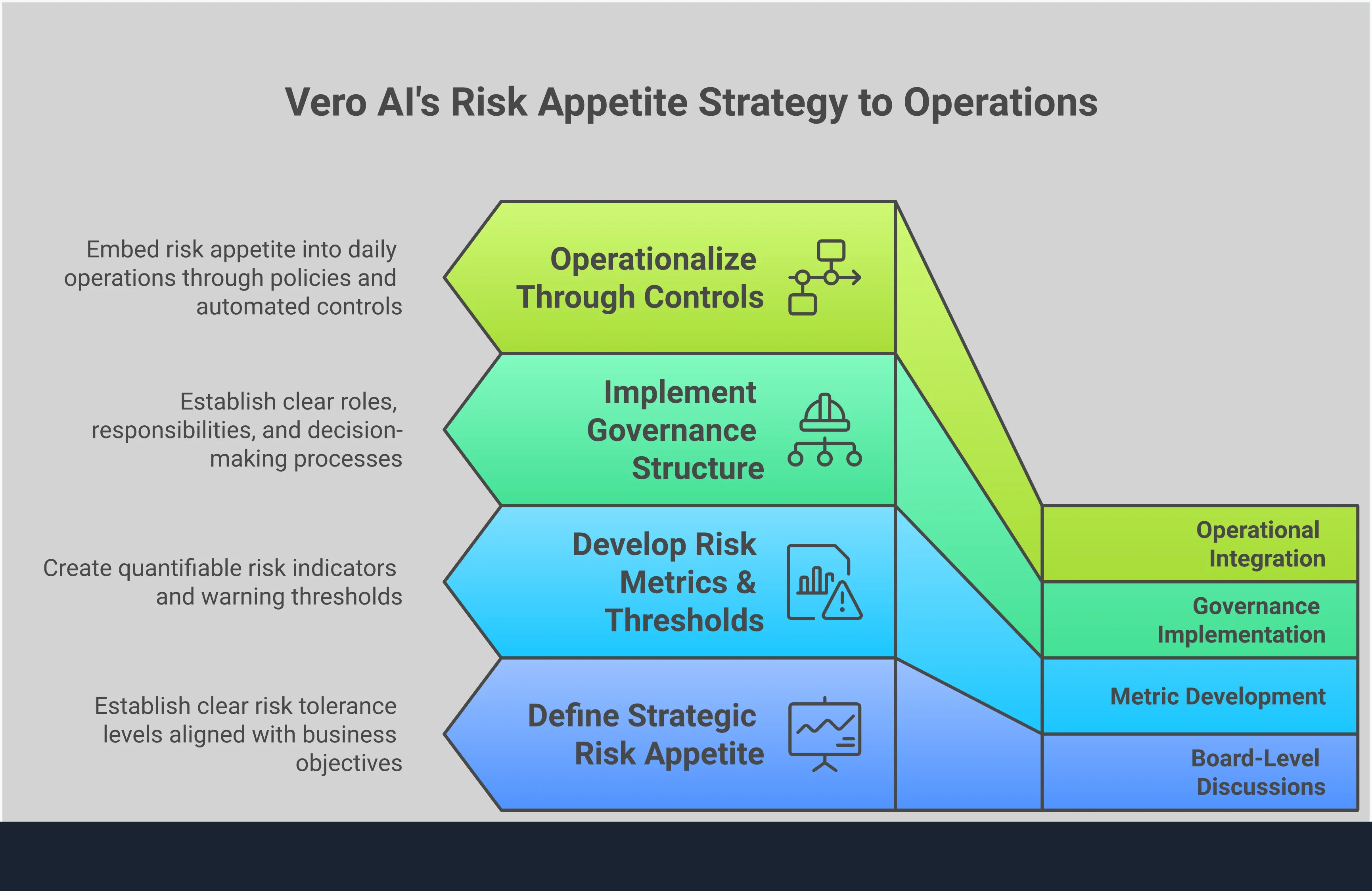
Determining your organization's risk appetite is a structured process, not an abstract exercise. It requires a deliberate approach that connects your strategic goals to your daily operations. By following a clear path, you can create a framework that guides decision-making, satisfies regulators, and gives your teams the clarity they need to act confidently. The following steps outline how to build a practical and effective risk appetite for your business.
Select a Risk Assessment Framework
Your first step is to choose a formal structure for assessing risk. A risk assessment framework provides a consistent method for identifying, analyzing, and evaluating risks across your organization. Defining risk appetite is a highly strategic decision, and a good framework ensures it aligns with your compliance duties and business goals.
Popular options include the COSO Enterprise Risk Management (ERM) Framework and ISO 31000. These models offer proven methodologies for integrating risk management into governance and strategy. Selecting a framework gives you a common language and a clear roadmap for the entire process, making it easier to implement and communicate.
Engage Leadership and Stakeholders
Risk appetite cannot be defined by the compliance team alone. It requires active participation from leaders across the business. Involving stakeholders ensures the final framework reflects the organization's collective wisdom and tolerance for risk. This conversation should include the board of directors, C-suite executives, and leaders from key business units.
This collaborative process helps align the organization's risk-taking with its strategic objectives. When leadership is involved from the start, the risk appetite becomes a shared responsibility. It moves from a document on a shelf to a living part of the company's culture and decision-making process.
Develop Your Risk Appetite Statement
The final output of this process is a formal Risk Appetite Statement (RAS). This document defines how much risk your organization is willing to accept in pursuit of its objectives. It acts as a guide for consistent decision-making at all levels. An effective RAS is clear, concise, and easy for everyone to understand.
Your statement should include both qualitative descriptions and quantitative metrics. For example, you might state a zero tolerance for regulatory compliance failures while setting specific financial limits for new investments. This combination provides clear guardrails for your teams. A well-crafted risk appetite statement influences everything from strategic planning to daily operations.
What Are the Different Levels of Risk Appetite?
An organization's risk appetite exists on a spectrum. It is shaped by its industry, strategic goals, and internal culture. Understanding where your company falls on this spectrum is key to building an effective governance, risk, and compliance (GRC) program. Most companies fit into one of three levels: conservative, balanced, or aggressive. Each level reflects a different view on the trade-off between risk and reward. Identifying your approach helps align audit and compliance efforts with the company's core strategy.
The Conservative Approach
A conservative risk appetite means an organization is reluctant to accept risk. The primary focus is on preserving value and maintaining stability. This approach is common in highly regulated industries like banking and healthcare, where compliance failures can lead to severe penalties and reputational damage. Organizations with this appetite implement strict internal controls and avoid ventures with uncertain outcomes. They may be slow to adopt new technologies or enter new markets, preferring proven methods over experimental ones. The goal is not to eliminate all risk, but to avoid it wherever practical and maintain a strong, defensible compliance posture.
The Balanced Approach
A balanced risk appetite represents a middle ground. Organizations with this mindset accept moderate risk to achieve strategic objectives. They pursue growth with caution and careful planning, requiring a clear understanding of which risks are acceptable. These organizations invest in robust mitigation strategies to manage potential downsides effectively. For example, a company might expand into a new geographic market only after extensive research or launch a new product with a limited pilot program. The key is making informed decisions where the potential reward justifies the understood risk, ensuring that growth initiatives do not compromise core stability.
The Aggressive Approach
An aggressive risk appetite means an organization accepts significant risks in the pursuit of high returns. This approach is often found in fast-growing sectors like technology or in startups trying to disrupt established markets. These companies prioritize innovation and speed over stability, viewing calculated risks as necessary for gaining a competitive edge. For these organizations, failure is often seen as a part of the innovation process. They might invest heavily in untested technologies or new business models to gain a first-mover advantage. A risk management framework is still important, but it is designed to manage high-stakes risks rather than avoid them.
Aligning Risk Appetite with Regulatory Requirements
An organization’s risk appetite is not just an internal guide. It is a critical component of your governance framework that must align with external rules and expectations. Regulators want to see that your company has a thoughtful, well-defined approach to risk that is actively used to make decisions. This alignment is not about eliminating all risk; it is about choosing which risks to take in pursuit of your objectives while staying within legal and ethical boundaries.
Connecting your risk appetite to specific regulatory requirements makes your compliance program more coherent and defensible. It shows auditors and regulators that your internal controls are tied directly to your strategy. When your team understands the company’s appetite for compliance risk, they can make more consistent decisions. This process helps build a resilient organization that can adapt to changing rules while protecting its reputation and financial stability.
Navigating Evolving Regulations
Regulatory environments are constantly changing. A clearly defined risk appetite acts as a stable guide for your compliance team, helping them interpret new or ambiguous rules. The key is to translate broad statements into specific, measurable metrics. For example, a company with a "low tolerance for supplier non-compliance" might define that as allowing no more than 2% of its suppliers to operate without complete documentation, according to research from Z2Data. This turns a high-level principle into a clear operational target that can be tracked and reported on, ensuring your actions consistently match your stated appetite.
Overcoming Resource and Technology Gaps
Many compliance teams struggle to monitor their risk exposure continuously with limited resources. Manual testing and periodic reviews can leave significant gaps, making it difficult to know if you are operating within your stated risk appetite. According to KPMG, modern compliance programs are expected to be technology-enabled and evaluated on an ongoing basis. Using automated analytics and digital processes helps bridge the gap between your compliance goals and your day-to-day operational reality. Technology allows you to test controls more frequently and consistently, providing a more accurate picture of your compliance posture at any given moment.
Achieving Board and Stakeholder Alignment
A risk appetite is only effective if it is understood and applied across the organization. Internal auditors play a crucial role in ensuring this alignment happens. They must communicate effectively with the board, management, and other stakeholders to confirm that the risk appetite is integrated into key decision-making processes. When everyone from the C-suite to the front lines understands the company’s boundaries for risk-taking, it creates a unified culture of compliance. This shared understanding ensures that strategic objectives and daily operations are pulling in the same direction.
How to Communicate Risk Appetite Effectively
Defining your organization's risk appetite is only the first step. To make it effective, you must communicate it clearly across all levels of the business. When every team member understands the boundaries for acceptable risk, they can make consistent, aligned decisions.
Effective communication turns a formal statement into a practical guide for daily operations. It ensures that your strategic goals are supported by a shared understanding of risk, from the boardroom to the front lines. This alignment is critical for building a resilient and risk-aware culture.
Create a Clear Risk Appetite Statement
A Risk Appetite Statement (RAS) is a formal document that defines the amount and type of risk your organization is willing to accept to meet its strategic objectives. According to MetricStream, a well-defined statement ensures that your company’s goals align with its risk tolerance. Think of it as the foundation for your entire risk communication strategy.
Your statement should be simple, clear, and easy for everyone to understand. Avoid jargon and complex metrics. Instead, focus on creating practical guidelines that connect high-level strategy to everyday business activities. This document guides consistent decision-making and helps teams evaluate opportunities with a clear sense of approved boundaries.
Engage Your Team Through Training
A document alone cannot create a risk-aware culture. You need to embed the principles of your risk appetite statement into the organization through ongoing training and engagement. This process should start with senior management to demonstrate commitment from the top.
As experts at Quantivate note, developing a shared framework for defining and monitoring risk appetite helps align risk management with performance goals. Regular training sessions ensure that every employee understands their role in managing risk. This creates a common language and a consistent approach, allowing teams to identify and address issues before they escalate. It transforms risk management from a compliance exercise into a collective responsibility.
Use Visuals and Feedback Loops
Consistent communication helps stakeholders understand and act on risk information. Using data-backed visuals like dashboards, heat maps, and charts can make abstract risk concepts more concrete and easier to grasp. These tools help leaders and teams see where the organization stands in relation to its stated risk appetite.
Establishing feedback loops is also essential. Create channels for employees to ask questions and report concerns about risk without fear of blame. This two-way communication provides valuable insights into how risk appetite is being applied on the ground. It also helps you refine your risk management framework over time, ensuring it remains relevant and effective as business conditions change.
How Risk Appetite Shapes Audit and Compliance
An organization's risk appetite is more than a theoretical statement. It directly influences the daily work of audit and compliance teams. When defined clearly, it acts as a bridge between high-level business strategy and on-the-ground control activities. It provides a framework for prioritizing resources, designing effective controls, and making consistent, defensible decisions.
Without this connection, audit plans can become disconnected from business objectives. Compliance can feel like a simple box-checking exercise. A well-understood risk appetite transforms these functions into strategic partners. They can better advise the business on where to focus attention and how to pursue goals without taking on unacceptable levels of risk. This alignment ensures that governance, risk, and compliance efforts support the organization's long-term success.
Aligning with the Audit Plan
A clear risk appetite is essential for creating a relevant and effective internal audit plan. The plan should directly reflect the areas where the organization has decided to take on more risk to achieve its goals. This ensures that audit resources are concentrated on the most critical issues facing the business.
Internal auditors work with management to understand these strategic priorities. This communication ensures the audit plan reflects the organization's risk appetite. Instead of auditing everything equally, teams can prioritize reviews of high-risk business units, new product launches, or critical systems. This targeted approach provides the board and leadership with assurance that the biggest risks are being managed effectively.
Integrating with Risk Management Frameworks
Risk appetite is a cornerstone of any sound risk management framework. It establishes the boundaries and thresholds for the impacts an organization is willing to accept while pursuing its objectives. This integration is key for aligning risk management activities with overall business goals.
A well-defined risk appetite statement provides a clear structure for designing and implementing controls. For example, if an organization has a low appetite for information security risk, its compliance framework will include stringent access controls and data protection measures. This helps teams move beyond a simple checklist approach. It allows them to build a risk management strategy that is tailored to the company's specific strategic context and tolerance for risk.
Supporting Stakeholder Decisions
A clearly communicated risk appetite helps stakeholders at all levels make informed and consistent decisions. From the board room to the front lines, understanding the organization's risk boundaries provides a common language for evaluating choices. It helps leaders decide which opportunities to pursue and which to avoid.
This clarity is vital for building a risk management system that supports the company's objectives. When stakeholders understand the organization's risk tolerance, they can confidently make choices that align with it. For compliance teams, this provides a defensible rationale for their work. It helps them explain to auditors and regulators why certain controls are in place and why specific residual risks have been accepted, creating a transparent and accountable culture.
How to Apply Risk Appetite to Decision-Making
A defined risk appetite is a practical tool that guides choices at every level of your organization. When applied correctly, it connects high-level strategy to daily operations. This creates a consistent approach to managing uncertainty. It ensures that every team, from product development to finance, makes decisions that align with the company's overall goals and risk boundaries.
Integrate with Strategic Planning
Your risk appetite should be a foundation for your strategic plan, not an afterthought. It defines the boundaries for pursuing your goals. When you align risk appetite with strategy, you ensure that growth initiatives are evaluated for both potential returns and associated risks. This creates a more balanced path forward.
This integration makes risk-taking an intentional part of your strategy. According to research from TrustCloud, a clear risk appetite is a strategic foundation that shapes how a company operates. It helps leadership answer critical questions by providing a clear framework for acceptable risk.
Apply to Operational Risk Management
On a daily basis, your risk appetite guides operational decisions. It gives teams a clear threshold for the impacts they can absorb while working toward their goals. This is important for managers who handle project approvals and resource allocation. With a defined risk appetite, they can make informed choices that support objectives without exposing the organization to unnecessary danger.
For example, a project team can use the risk appetite to assess a new software vendor's security posture. This practical application turns the risk appetite into a tool for everyday risk management, preventing small risks from becoming significant problems.
Embed in Your Governance Framework
To be effective, risk appetite must be embedded in your governance framework. This often starts with a formal Risk Appetite Statement (RAS). A Risk Appetite Statement defines the amount and type of risk the organization will accept. It serves as a reference point for decision-making and ensures consistency across departments.
This statement should be supported by clear communication and training, starting with senior management. When leadership consistently references the risk appetite, it helps build a risk-aware culture. This shared framework helps align risk management practices with performance goals, ensuring it is understood and applied.
Related Articles
FAQs: Risk Appetite
Table of Contents

Eric Sydell, PhD
Eric has two decades of experience in enterprise technology and was a founder of Modern Hire, which became part of Hirevue in 2023.