Article
Risk Tolerance vs Risk Appetite: A Simple Guide

Eric Sydell, PhD
|
Updated on
|
Created on
Building a strong risk management program is like constructing a bridge. First, you need a high-level plan approved by leadership. This plan defines the bridge's purpose, its capacity, and the overall level of structural risk you are willing to accept to get it built on time and on budget. This is your risk appetite. But that high-level plan is not enough for the engineers on the ground. They need specific, measurable limits for material strength and construction variance. These are your risk tolerances. The discussion of risk tolerance vs risk appetite is about connecting the blueprint to the build. Without tolerance, the appetite is just a vision. Without appetite, the tolerances lack strategic direction.
Key Takeaways
Separate strategy from operations: Risk appetite sets the high-level, strategic direction for acceptable risk, while risk tolerance defines the specific, measurable limits for daily activities.
Align appetite with tolerance for clear guidance: An effective risk program requires both concepts to function together. Appetite provides the "why" behind taking risks, and tolerance provides the operational guardrails that keep teams aligned with strategic goals.
Treat your framework as a living document: A risk framework is not a static document. It needs regular reviews with stakeholders to stay relevant and effective as your organization's objectives and the business environment change.
What Are Risk Appetite and Risk Tolerance?
In governance, risk, and compliance (GRC), the terms risk appetite and risk tolerance are often used together. While they are related, they describe two distinct concepts. Understanding the difference is essential for building an effective risk management program. Risk appetite sets the strategy, while risk tolerance defines the operational limits.
Risk Appetite: A Strategic Guide
Think of risk appetite as your organization's guiding philosophy on risk. It is a high-level statement that defines the amount and type of risk your company is willing to accept to achieve its strategic objectives. This statement is typically qualitative and is set by the board of directors and senior leadership.
Risk appetite provides a general outline of acceptable risks. For example, a technology startup might have a high appetite for innovation risk to develop new products. A financial institution, on the other hand, will have a very low appetite for compliance risk. This framework helps align the entire organization on how to approach opportunities and threats in pursuit of its goals.
Risk Tolerance: An Operational Boundary
Risk tolerance translates the high-level risk appetite into practical, measurable limits. It defines the specific level of risk the organization can handle for a particular initiative or area. If risk appetite is the general willingness to take risks, tolerance sets the hard lines that should not be crossed.
According to ISACA, risk tolerance is the acceptable deviation from the organization's risk appetite. For instance, a company’s appetite might be to accept moderate cybersecurity risk. Its risk tolerance could be defined as "no more than two high-severity vulnerabilities in production systems at any time." These specific metrics give managers clear boundaries for day-to-day decision-making.
Key Risk Management Terms to Know
To put it simply, risk appetite and risk tolerance answer two different questions. Risk appetite asks: "How much risk are we willing to take on to succeed?" It connects risk-taking directly to the pursuit of strategic goals, including financial and operational impacts.
Risk tolerance asks: "What are the specific limits of that risk-taking?" It focuses on the acceptable variance in outcomes related to specific performance measures. By defining both, an organization creates a comprehensive framework that guides strategic direction while managing operational performance and preventing unacceptable losses. This clarity is crucial for consistent and defensible decision-making.
How Do Risk Appetite and Risk Tolerance Differ?
Risk appetite and risk tolerance are core concepts in enterprise risk management, yet they are often confused. While they are closely related, they are not interchangeable. Understanding their differences is essential for building a sound governance framework that connects high-level strategy with daily execution. Risk appetite sets the overall tone from the top, defining the amount of risk the organization is willing to seek or accept in pursuit of its goals. Risk tolerance translates that tone into specific, measurable limits that guide operational decisions.
Think of it like planning a road trip. Your risk appetite is the high-level decision to drive instead of fly, accepting the general risks of the road to gain the flexibility of having your own car. It’s a strategic choice about the journey itself. Your risk tolerance provides the specific rules for that journey, like not driving more than 10 miles per hour over the speed limit or stopping for a break every two hours. These are the operational controls that keep you safe and on track. One is a strategic choice, and the other is a tactical boundary. Effective risk governance requires both elements working together. Without tolerance, appetite is just a vague statement. Without appetite, tolerance lacks strategic direction.
Strategic vs. Operational Focus
The primary difference between risk appetite and risk tolerance lies in their focus. Risk appetite is strategic. It defines the amount and type of risk an organization is willing to accept to achieve its strategic objectives. This high-level statement is typically set by the board of directors and senior leadership. It answers the broad question: "How much risk are we prepared to take to meet our goals?" For example, a tech startup might have a high appetite for innovation risk to develop a new product.
Risk tolerance, on the other hand, is operational. It sets the specific, acceptable level of variation from the risk appetite. It provides clear boundaries for employees and managers in their daily activities. Following the tech startup example, its risk tolerance might specify that no single project can exceed its budget by more than 15%. Risk appetite guides the big picture, while risk tolerance provides the guardrails for individual projects and departments.
Qualitative vs. Quantitative Measures
Another key distinction is how each concept is measured and expressed. Risk appetite is often described in qualitative terms. These are broad statements that reflect the organization's overall attitude toward risk. A healthcare provider might state it has a "low appetite for risks that could compromise patient safety." This is a guiding principle, not a hard number. It sets a clear cultural tone and direction for the entire organization.
Risk tolerance translates that qualitative appetite into quantitative, measurable metrics. It makes the appetite actionable. For the healthcare provider, a specific risk tolerance might be "a maximum of 0.1% medication error rate" or "zero tolerance for data breaches of protected health information." These are concrete thresholds that can be monitored and reported on. Using quantitative measures allows teams to know exactly when a deviation requires attention or escalation, ensuring the qualitative appetite is upheld in practice.
Application in Timing and Decision-Making
Risk appetite and risk tolerance are applied at different stages of the decision-making process. Risk appetite is a forward-looking concept used during strategic planning. When considering new markets, products, or investments, leadership uses the risk appetite statement to evaluate whether an opportunity aligns with the organization's willingness to take on risk. It helps answer the question, "Should we do this?"
Risk tolerance is applied in real-time to manage ongoing operations and projects. It is a tool for monitoring and control, helping managers make tactical decisions. It answers the question, "Are we operating within our acceptable limits?" For instance, a project manager would use budget and timeline tolerances to manage a project day-to-day. When both are working in concert, the strategic goals defined by the risk appetite are protected by the operational controls set by risk tolerance.
Why Your Organization Needs Both
Risk appetite and risk tolerance are distinct but connected concepts. Using one without the other can lead to confusion and inconsistent risk management. A strong governance program needs both to connect high-level strategy with day-to-day operational decisions, satisfy regulators, and support clear decision-making.
Align Strategy with Operations
A clear risk appetite acts as a guidepost for decisions across the company. It is a strategic foundation that shapes how an organization operates and grows. This high-level statement connects your business goals to your risk management practices.
Risk tolerance then translates that strategy into specific, measurable limits. A risk appetite framework outlines the amount of risk you will accept to achieve your objectives. This ensures that operational teams have clear boundaries for their daily work, keeping their actions aligned with the company's broader goals.
Meet Regulatory and Compliance Requirements
Regulators and auditors expect organizations to have a formal risk management process. Failing to define risk appetite and tolerance can undermine this entire process. Without them, it's difficult to demonstrate a clear understanding of your risk landscape to external parties.
Your framework must also reflect the external regulatory environment. Organizations need to tailor their approach to industry-specific threats and compliance rules. Having both appetite and tolerance statements shows that your company is diligent in its governance and prepared for scrutiny during audits for frameworks like SOC 2 or ISO 27001.
Support Effective Decision-Making
Clear risk definitions help your teams make better decisions. Risk appetite provides the strategic context, while risk tolerance sets the practical limits. When these two elements work together, they create a system for effective risk governance.
This clarity empowers employees at all levels to act with confidence. They understand the boundaries and don't need to escalate every minor issue. Involving stakeholders from different departments in this process ensures the framework reflects the collective wisdom of the organization. This collaborative approach builds a stronger, more risk-aware culture.
How to Define Your Risk Appetite and Tolerance
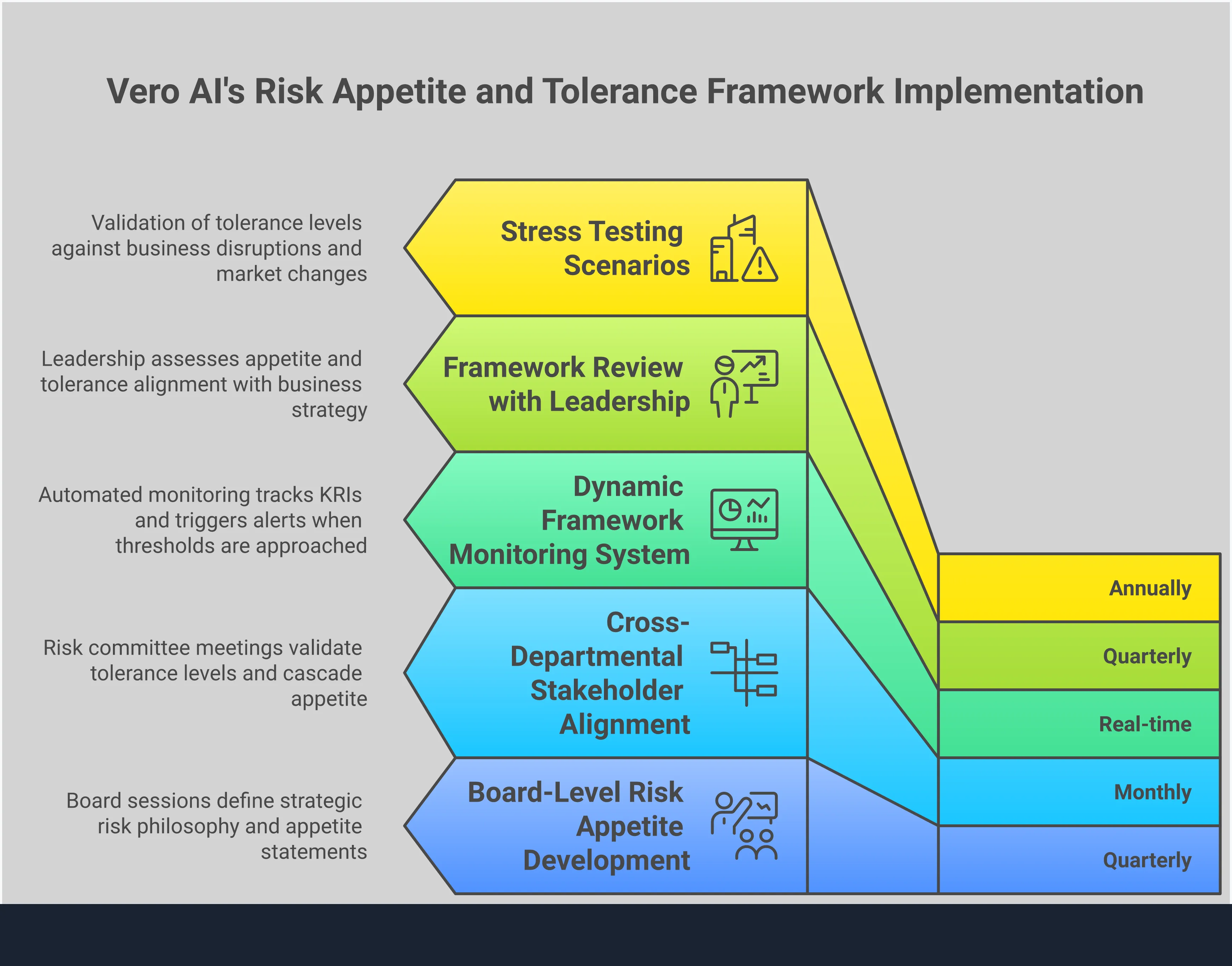
Defining your organization's risk appetite and tolerance is a structured process. It requires input from leadership, collaboration across departments, and clear documentation. This process transforms abstract ideas about risk into concrete guidelines that inform daily decisions and long-term strategy. By following a clear methodology, you can create a framework that aligns your entire organization around a shared understanding of acceptable risk. These steps provide a practical path for establishing and formalizing your company’s approach to risk management.
Assess Risk Appetite at the Board Level
Risk appetite is a strategic conversation that starts at the top. The board of directors and senior leadership are responsible for setting the organization's overall vision for acceptable risk. This high-level statement should align directly with the company’s mission, financial goals, and strategic objectives. It answers the broad question: "How much risk are we willing to take to achieve our goals?"
As the risk advisory firm FieldGuide notes, "Appetite establishes board-level vision for acceptable risk, while tolerance creates specific operational thresholds for daily decisions." This initial step is qualitative and directional. It sets the tone for the entire risk management program without getting lost in specific metrics.
Use Quantitative Methods for Risk Tolerance
Once the board defines the risk appetite, the next step is to translate that broad vision into specific, measurable limits. This is where risk tolerance comes in. Tolerance sets the operational boundaries that teams must work within. It defines the maximum level of risk the organization can handle for a specific risk category before it must take action.
According to ISACA, an association for IT governance professionals, risk tolerance is best communicated in quantitative terms. This could include metrics like a maximum acceptable financial loss, a specific percentage of project delays, or a target for system uptime. These numbers give managers and employees clear, unambiguous thresholds for their day-to-day activities.
Engage Stakeholders and Document Standards
Defining risk appetite and tolerance is not a task for a single department. It requires input from stakeholders across the organization, including department heads, operational managers, and legal and compliance teams. This collaborative approach ensures the resulting framework is both realistic and relevant to the entire business.
As the compliance platform TrustCloud explains, "involving stakeholders ensures that the risk appetite framework reflects the collective wisdom and tolerance levels of the organization." Once established, these standards must be formally documented in a risk appetite statement. This document becomes the official source of truth, guiding decision-making and providing a clear reference for everyone from new hires to external auditors.
Use Established Risk Management Frameworks
You don’t need to create your risk management process from scratch. Established frameworks like COSO (The Committee of Sponsoring Organizations of the Treadway Commission) and ISO 31000 offer proven methodologies for identifying, assessing, and managing risk. These frameworks provide a structured approach for defining your risk appetite and integrating it into your overall governance structure.
Using a recognized risk appetite framework helps ensure your process is comprehensive and defensible. It provides a common language and structure that simplifies communication with regulators, auditors, and board members. This alignment with industry standards demonstrates a mature approach to risk management and strengthens your compliance posture.
Common Implementation Challenges
Defining risk appetite and risk tolerance is a critical first step. But turning these concepts into an effective, working framework presents its own set of challenges. Many organizations create detailed statements that ultimately fail to influence day-to-day decisions. The gap between theory and practice can leave a company exposed to unforeseen risks, even with a documented risk management plan in place.
These implementation hurdles often stem from a few common areas. There might be a disconnect between the high-level strategic vision and the operational realities on the ground. Communication gaps can leave teams confused about what is expected of them. Sometimes, the framework is treated as a compliance document instead of a living guide for decision-making. Finally, in a constantly changing business environment, a static framework can quickly become irrelevant. Overcoming these obstacles is essential for building a resilient organization where risk is managed proactively, not just reactively.
Misalignment Between Appetite and Tolerance
A common issue arises when a company’s high-level risk appetite does not connect to its operational risk tolerance. The board might approve a broad statement about pursuing innovation, but the front-line teams lack clear, measurable limits for their projects. This disconnect forces them to make judgment calls without strategic guidance.
An effective enterprise risk management framework requires a clear link between these two elements. Without it, different departments may operate with conflicting assumptions. One team might take on significant risks to meet a goal, while another acts too cautiously, hindering progress. This misalignment leads to inconsistent decision-making that can undermine strategic objectives.
Gaps in Communication
Even a well-designed framework is ineffective if it is not clearly communicated and understood across the organization. If employees do not know what the risk appetite and tolerance levels are, they cannot apply them to their work. This lack of clarity can create confusion and lead to inconsistent actions.
As one CIO article notes, failing to define these terms undermines any risk management process. When communication is poor, teams are left to interpret risk on their own. This can result in some departments taking on unacceptable levels of risk while others avoid necessary risks that could drive growth. Clear, consistent communication ensures everyone is working from the same set of rules.
Difficulty Integrating into Daily Operations
Many organizations treat their risk framework as a document for auditors rather than a practical tool for daily use. The principles are defined but never fully integrated into core business processes like budgeting, strategic planning, or product development. When risk management is not part of the daily workflow, it becomes an afterthought.
A risk appetite should be a "strategic foundation that shapes how an organization operates," according to TrustCloud. To be effective, risk considerations must be embedded in the tools and routines that employees use every day. Without this integration, the framework remains a theoretical exercise with little impact on how the company actually performs.
Managing a Static vs. Dynamic Framework
The business environment is not static, and neither is risk. New competitors emerge, regulations change, and economic conditions shift. A risk framework developed one year may not be relevant the next. Yet, many organizations fail to review and update their risk appetite and tolerance levels regularly, treating them as a one-time project.
A framework that lacks a "clear strategic anchor" can quickly become obsolete, as noted by Comsure. An effective risk framework must be a living document. It should be revisited and adjusted in response to internal changes, like new business objectives, and external events. A dynamic approach ensures the framework remains a relevant and useful guide for navigating future uncertainties.
How to Overcome Implementation Challenges
Defining risk appetite and tolerance is a critical first step. Turning those definitions into practice, however, requires a structured and continuous effort. Organizations often face challenges in aligning their high-level risk appetite with day-to-day operational decisions. The key is to build a system that connects strategy to action, making risk management a practical part of your organization's culture. By focusing on clear frameworks, regular reviews, and data-driven monitoring, you can bridge the gap between theory and execution.
Develop a Clear Risk Appetite Framework
A risk appetite framework is a formal document that guides decision-making. It outlines the amount and type of risk an organization is willing to accept to achieve its objectives. According to Metricstream, a risk appetite framework "enhances risk management by setting clear thresholds, aligning daily operations with strategic goals, and providing stakeholder confidence."
This framework acts as a central reference point. It ensures everyone from the board to front-line managers understands the boundaries for risk-taking. By creating this clarity, you reduce the chances of misalignment between different departments and ensure that all parts of the business are working toward the same strategic goals with a shared understanding of risk.
Continuously Review and Adapt
Your business strategy and the market are not static, so your risk appetite should not be either. A common mistake is treating the risk appetite statement as a one-time project. Instead, it should be a living document that evolves with your organization.
As noted by TrustCloud, defining risk appetite is a "strategic foundation that shapes how an organization operates, grows, and survives in dynamic markets." To keep this foundation strong, you should schedule regular reviews of your risk appetite and tolerance levels. An annual or quarterly review with key leaders ensures your risk framework remains relevant and aligned with your current strategic objectives, helping you adapt to new challenges and opportunities.
Embed Risk Management into Your Culture
For risk management to be effective, it must be part of your organization's culture. It cannot be the sole responsibility of the compliance or audit team. Leadership plays a vital role in connecting risk management to the company's core mission and values.
By linking risk appetite directly to strategy, leaders can navigate uncertainty and ensure decisions are consistent and principled. When employees understand how their actions contribute to the organization's overall risk posture, they are more likely to make responsible choices. This integration turns risk management from a compliance exercise into a shared commitment to building a resilient and successful business.
Monitor Performance with Data Analytics
To connect your high-level risk appetite with daily activities, you need to measure what matters. This is where data and analytics become essential. By establishing key risk indicators (KRIs), you can monitor your performance against the specific risk tolerances you have set.
According to LogicManager, it is important to "identify and define risk tolerances at the front-line process level." When these tolerances are tracked with data, you gain an objective view of your risk exposure. This allows you to spot deviations from your accepted risk levels early and make adjustments before small issues become significant problems. Consistent monitoring makes your risk framework actionable and transparent.
Making Risk Appetite and Tolerance Work Together
Risk appetite and risk tolerance are not meant to be used in isolation. They are two parts of a single, cohesive risk management strategy. When used together, they connect your organization's high-level goals with its day-to-day operational decisions. Risk appetite sets the overall direction, defining the amount of risk the board is willing to accept to achieve its objectives. Risk tolerance then translates that direction into specific, measurable limits that guide teams on the ground.
This connection is what makes risk management practical. It moves the conversation from abstract ideas to concrete actions. Without clear tolerance levels, your risk appetite statement is just a document that sits on a shelf. Without an appetite statement, your tolerance levels lack strategic purpose and can feel arbitrary to the teams expected to follow them. An effective program requires both elements to function as a unified system that informs decisions at every level of the business. This involves integrating them into your enterprise risk management, establishing clear monitoring processes, and linking your entire framework back to your core business goals. This ensures that the organization can navigate risks while pursuing its strategic objectives.
Integrate Both into Enterprise Risk Management
Your risk appetite and tolerance should be foundational elements of your Enterprise Risk Management (ERM) program. This integration ensures that risk is considered in a consistent way across the entire organization. The process typically starts at the top, with the board and senior leadership defining the overall risk appetite.
This high-level guidance is then cascaded down through the organization. Department heads and managers translate the broad appetite into specific risk tolerance levels for their teams, projects, and processes. This creates a clear and direct link between strategic intent and operational execution. When done correctly, every employee understands how their daily responsibilities contribute to the organization's larger risk management objectives.
Establish Clear Monitoring and Reporting
Defining risk appetite and tolerance is only the first step. To make them effective, you must continuously monitor your organization's activities against the limits you have set. This requires establishing clear reporting mechanisms and using data to track performance.
These systems should provide timely information on where the organization stands relative to its risk tolerance thresholds. When a limit is approached or exceeded, the system should trigger an alert, allowing managers to take corrective action promptly. This proactive monitoring helps address small deviations before they become significant problems. It also provides leadership with the assurance that the organization is operating within its desired risk boundaries.
Link Your Risk Framework to Strategic Goals
Risk management should never be a siloed compliance exercise. Its primary purpose is to help the organization achieve its objectives safely and sustainably. To do this, you must explicitly link your risk appetite framework to your most important strategic goals.
This alignment ensures that your organization is taking the right risks to support growth and innovation. It helps everyone understand why certain risks are acceptable while others are not. By connecting risk management directly to business strategy, you transform it from a cost center into a value-driver. This approach supports better decision-making and helps ensure that risk-taking is always purposeful and aligned with your company's mission.
Related Articles
FAQs: Risk Tolerance vs Risk Appetite
Table of Contents

Eric Sydell, PhD
Eric has two decades of experience in enterprise technology and was a founder of Modern Hire, which became part of Hirevue in 2023.